
Kenya or Tanzania: Which Safari Destination Is Right for You?
Kenya and Tanzania are two of Africa’s most iconic safari destinations. Both offer extraordinary wildlife, beautiful landscapes and the chance to experience the Great Migration. Yet, although they share a border and many similarities, the overall travel experience can feel surprisingly different.
So, should you choose Kenya or Tanzania for your safari? The honest answer is that there is no wrong choice. It depends on the type of journey you are looking for.
The safari experience in Kenya
Kenya has been welcoming safari travellers for generations, and it shows. The tourism industry is highly professional, well organised and generally very reliable. We particularly love the warmth and friendliness of the Kenyan people. Guides, lodge teams and drivers have a wonderful way of making you feel welcome, often combining excellent service with a relaxed sense of humour.
Kenya also offers tremendous variety. A classic itinerary might include the open plains of the Masai Mara, the lakes and escarpments of the Great Rift Valley, the elephants of Amboseli with Mount Kilimanjaro in the background, and the rugged wilderness of Samburu.
One of Kenya’s greatest advantages is its accessibility. Nairobi is a major international hub, and domestic flights make it relatively easy to combine several different regions. Travel times can often be reduced by flying between parks, making Kenya particularly suitable if you want to experience a lot within a limited number of days.
Kenya also offers more than traditional game drives. Depending on your route, you can go cycling or hiking in Hell’s Gate National Park, visit conservation projects, meet local communities, enjoy a boat trip on one of the Rift Valley lakes or finish your journey on the Indian Ocean coast.
The conservancies surrounding the Masai Mara are another major highlight. These privately managed wildlife areas usually have fewer vehicles than the main reserve and allow experiences that are not always possible inside national parks, such as walking safaris, night drives and off-road game viewing.
The safari experience in Tanzania
Tanzania often feels more expansive and remote. Its northern safari circuit connects several spectacular wildlife areas, including Tarangire National Park, Lake Manyara, the Ngorongoro Crater and the Serengeti.
One of the things we particularly appreciate about Tanzania is the choice of small-scale lodges and tented camps. Many properties are intimate and atmospheric, with only a limited number of rooms or safari tents. This can make the experience feel wonderfully personal and close to nature.
The journeys between the parks are also part of the adventure. In Tanzania, you frequently travel through vast landscapes, rural villages, highlands and wildlife areas. Rather than simply moving from one attraction to another, you often remain surrounded by nature throughout much of the route.
The scale of Tanzania’s wilderness is difficult to describe until you experience it. The Serengeti seems to stretch endlessly towards the horizon, while the Ngorongoro Crater offers one of Africa’s most remarkable concentrations of wildlife. Tarangire, with its ancient baobab trees and large elephant herds, has a completely different character again.
Tanzania is particularly well suited to travellers who enjoy a slower, immersive safari. Staying several nights in one area allows you to explore at a relaxed pace, spend more time observing animal behaviour and appreciate the smaller details of the landscape.
Afterwards, it is easy to combine your safari with Zanzibar, where you can relax on a tropical beach, explore historic Stone Town, go snorkelling or diving, or stay in a quiet boutique hotel.
Wildlife and the Great Migration
Both countries offer exceptional wildlife viewing. Lions, elephants, giraffes, zebras, buffalo, hippos and many species of antelope can be seen in both Kenya and Tanzania. Leopard and cheetah sightings are possible too, although never guaranteed.
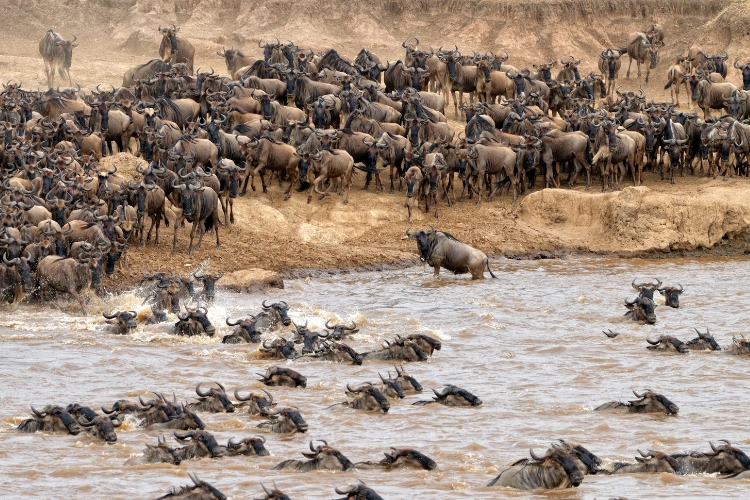
The Great Migration takes place throughout the year as vast herds of wildebeest and zebra move through the Serengeti–Mara ecosystem. The animals do not follow an exact schedule, as their movements depend largely on rainfall and the availability of fresh grass.
Broadly speaking, the herds spend much of the year in Tanzania’s Serengeti. The calving season normally takes place on the southern Serengeti plains between approximately January and March. During the northern summer months, the herds move towards the northern Serengeti and Kenya’s Masai Mara, when the famous river crossings may occur.
It is important to remember that the migration is much more than a river crossing. Seeing thousands of animals spread across the plains, newborn calves taking their first steps or predators following the herds can be just as memorable.
Atmosphere and accommodation
Kenya generally has a very polished and established safari industry. You will find everything from comfortable family-run camps to historic safari lodges and exclusive conservancy properties. Service is usually friendly, confident and highly professional.
Tanzania offers equally beautiful accommodation but often stands out for its intimate bush camps and small-scale lodges. Some camps are seasonal and move or close according to the migration and weather. The atmosphere can feel more remote, with nights spent listening to lions, hyenas or elephants beyond the canvas of your tent.
In both destinations, “tented camp” does not necessarily mean basic camping. Many safari tents have proper beds, private bathrooms, hot showers and verandas overlooking the wilderness. There are options for almost every comfort level and budget.
Road conditions and travelling distances
Road journeys are an important part of any East African safari. Distances can appear short on a map but take longer than expected due to road conditions, wildlife sightings and park regulations.
Kenya’s main safari circuit can involve travelling through busier towns and more developed areas between reserves. The advantage is that the infrastructure is often efficient and there are good possibilities for combining road transfers with domestic flights.
In Tanzania, the northern parks form a natural circuit. Once you leave the busier areas around Arusha, much of the journey passes through rural scenery, highlands and open landscapes. This makes the route itself feel like part of the safari.
In either country, we recommend avoiding an itinerary that tries to include too many parks in too few days. Fewer locations and longer stays usually create a more rewarding and relaxed experience.
Which destination is better for families?
Both Kenya and Tanzania are excellent family destinations, provided that the itinerary and accommodation are chosen carefully.
Kenya can be particularly appealing to active families because it offers such a broad range of experiences alongside game drives. Its good flight connections can also help reduce long travel days.
Tanzania works beautifully for families who want a classic, nature-focused safari with atmospheric camps and plenty of time in the bush. Some lodges offer family tents, swimming pools and activities designed especially for younger travellers.
Minimum-age restrictions may apply to walking safaris, certain activities and shared game drives, so it is important to match each family with the right accommodation.
Choose Kenya if you…
- Value exceptionally warm, friendly and professional service.
- Want to combine safari with culture, outdoor activities or the Kenyan coast.
- Prefer efficient connections and the option of flying between parks.
- Would like to stay in a private conservancy with fewer vehicles.
- Want to combine several contrasting landscapes within one journey.
Choose Tanzania if you…
- Dream of vast, uninterrupted wilderness.
- Prefer small-scale lodges and intimate tented camps.
- Want the journeys between parks to remain scenic and close to nature.
- Would like to combine the Serengeti, Ngorongoro Crater and Tarangire.
- Want to finish your safari with a beach stay on Zanzibar.
Can you combine Kenya and Tanzania?
Absolutely. Combining the Masai Mara and Serengeti creates an unforgettable cross-border safari, especially during the migration season. However, border crossings and flight connections need to be planned carefully, and a combined itinerary works best when you have enough time.
For a first safari of around ten to fourteen days, we often recommend focusing on one country and experiencing it properly. If you have more time, or are returning to East Africa, combining both countries can offer the best of two very different safari worlds.
Our conclusion
Kenya feels warm, welcoming, varied and wonderfully professional. Tanzania feels vast, immersive and deeply connected to the wilderness, with an excellent selection of small-scale lodges and camps.
Choose Kenya for its people, variety, conservancies and smooth safari infrastructure. Choose Tanzania for its scale, intimate accommodation and spectacular natural safari circuit.
Whichever country you choose, the most important thing is not to fit in as many parks as possible. A well-paced itinerary, the right guide and accommodation that suits your personal travel style will make far more difference than the number of places you visit.
Still unsure? At African Travels, we know both destinations personally and can help you create a safari that matches your wishes, travel dates, budget and preferred level of comfort.